| Model Type | Pose Estimation |
|---|---|
| Framework | LiteRT (TensorFlow Lite) |
| Algorithm | HRNet |
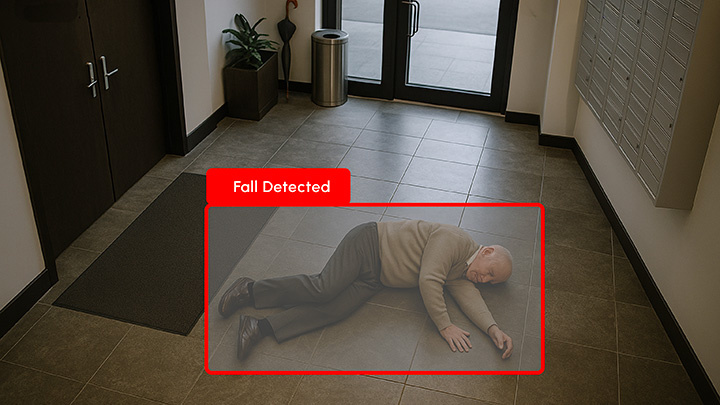
| Technical Details | This unit implements a fully heuristic, rule-based fall-detection algorithm that operates on a single human pose extracted from a static frame. It relies on skeletal keypoints generated by upstream pose-estimation models (e.g., HRNet) and evaluates the body geometry to determine whether a person is in a fallen state. The detection pipeline includes two logic paths: (1) a high-priority horizontal-pose check based on the bounding-box aspect ratio, and (2) a majority-voting system that combines multiple geometric indicators such as vertical compression, low-head/low-hip positioning, shoulder-tilt angle, and pose instability. These rules are designed to maximize sensitivity to real falls while reducing false positives in ambiguous poses. The system includes normalization of keypoints, validation of missing/low-confidence landmarks, and configurable thresholds to adapt the heuristic behavior. As a rule-based model, it is lightweight, requires no ML inference, and is highly suitable for low-power edge devices. Its effectiveness depends strongly on the quality of upstream pose detection and does not incorporate temporal motion analysis. |
Human Fall Detection
AI vision application to detect human falls in real time for safety, elderly care, and industrial risk monitoring.
Leave your message here
Fill the form with the required information
$0.00
Human Fall Detection
app details
Resources
Use Cases
Industrial Safety
Industrial Surveillance
Surveillance
Security
Supported SECO Devices
AI optimized hardware
Fanless embedded PCs
Modules
supported chipsets
Intel
Intel® Core™ i3
Qualcomm
Qualcomm® Dragonwing QCS6490
Qualcomm® Dragonwing QCS5430
NXP
NXP i.MX 8M Plus
NXP i.MX 95

PoseNet for Multi-Person Pose Detection
Lightweight and quantized PoseNet model for real-time multi-person pose estimation on edge hardware.
View Model
HRNet for Human Pose Estimation
High-resolution neural network for accurate keypoint detection in human pose estimation tasks.
View Model|
|